Hydrangeas Can Bloom Beautifully… But Most Gardeners Make This One Mistake!
Hydrangeas are among the most breathtaking flowering shrubs you can grow. Their enormous blooms can transform an ordinary garden into a sea of blue, pink, white, or purple flowers that last for months.
Yet every year, thousands of gardeners find themselves asking the same frustrating question:
“Why is my hydrangea healthy and full of leaves… but has no flowers?”
The answer is often surprisingly simple.
While several factors can prevent blooming, the single most common mistake is pruning at the wrong time.
Many gardeners unknowingly remove next year’s flower buds without realizing it.
The good news?
Once you understand how hydrangeas produce their blooms, preventing this mistake—and several others—is much easier.
The #1 Mistake: Pruning at the Wrong Time
This is by far the biggest reason hydrangeas fail to bloom.
Many popular hydrangeas, especially Bigleaf (Hydrangea macrophylla) and Oakleaf hydrangeas, produce flower buds on old wood.
That means the buds that bloom next summer actually formed during the previous summer and autumn.
If you prune these shrubs in late fall, winter, or early spring, you’re not just trimming branches—you may be cutting off every flower before it has a chance to bloom.
The plant stays healthy.
The leaves grow beautifully.
But the flowers never appear.
How to Avoid It
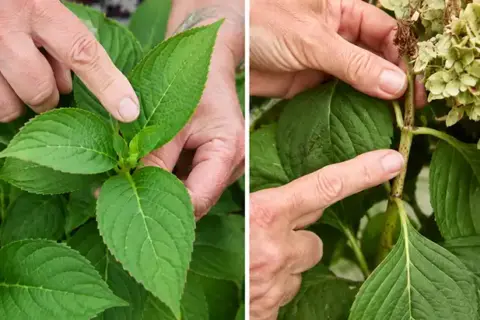
Before pruning, identify what type of hydrangea you have.
If it blooms on old wood:
- Only remove dead or damaged branches.
- Prune immediately after flowering if shaping is necessary.
- Avoid heavy pruning in late fall or spring.
Some newer reblooming varieties can flower on both old and new wood, making them more forgiving, but proper timing still encourages the best display.
1. Too Much Shade
Hydrangeas enjoy light, but not all light is equal.
Many gardeners assume they are full-shade plants because they tolerate partial shade.
In reality, most varieties bloom best with:
- Morning sunlight
- Bright filtered afternoon light
- About 4–6 hours of sun daily
Plants growing in dense shade often produce lush green foliage with very few flowers.
Solution
If possible:
- Trim nearby branches.
- Move container-grown plants.
- Choose a brighter location without intense afternoon heat.
2. Late Spring Frost Damage
Hydrangea flower buds are surprisingly vulnerable.
After a warm spell, buds begin to swell.
If a hard frost arrives afterward, those developing flower buds may die.
The shrub survives.
Leaves emerge normally.
But flowering is delayed—or completely absent.
Solution
When late frosts are forecast:
- Cover shrubs overnight with frost cloth.
- Remove coverings in the morning.
- Mulch around roots to stabilize soil temperature.
3. Too Much Nitrogen Fertilizer
Nitrogen encourages leafy growth.
While healthy leaves are important, excessive nitrogen tells the plant to focus on producing foliage instead of flowers.
This often happens when lawn fertilizer reaches nearby hydrangeas.
The result is:
- Huge green plants
- Thick stems
- Very few blooms
Solution
Choose a balanced fertilizer or one formulated specifically for flowering shrubs.
Avoid repeatedly feeding with high-nitrogen lawn fertilizers.
4. Not Enough Water During Bud Formation
Hydrangeas have earned their name for a reason.
The word “Hydrangea” comes from Greek words meaning “water vessel.”
When flower buds are forming, drought stress can reduce blooming dramatically.
Even if the plant survives dry weather, it may sacrifice flowers to conserve energy.
Solution
Provide:
- Deep watering once or twice per week
- Mulch around the root zone
- Consistently moist—not waterlogged—soil
5. Improper Winter Protection
Cold winters can kill flower buds before spring arrives.
Even though the shrub itself survives, damaged buds never develop into flowers.
This problem is especially common in colder climates with fluctuating winter temperatures.
Solution
In late autumn:
- Apply a thick mulch layer around the roots.
- Protect exposed plants with burlap during severe cold.
- Avoid stimulating late-season growth with fertilizer.
6. The Plant Is Still Young
Patience matters.
Recently planted hydrangeas often spend their first years developing strong root systems.
Instead of producing dozens of flowers immediately, they invest energy underground.
Many young shrubs bloom lightly at first before reaching full flowering after several growing seasons.
Solution
Continue providing proper care and resist the urge to over-fertilize.
Healthy roots usually lead to better flowering over time.
7. Growing the Wrong Variety for Your Climate
Not every hydrangea performs equally well everywhere.
Some varieties struggle in very cold regions.
Others dislike intense summer heat.
Choosing a shrub poorly suited to your local climate often results in weak flowering despite excellent care.
Solution
Before planting, select varieties recommended for your USDA hardiness zone or local climate.
Local nurseries usually stock cultivars proven to perform well in your area.
Bonus Tip: Don’t Panic Too Early
Hydrangeas often leaf out weeks before flower buds become obvious.
Many gardeners assume the plant has failed long before blooming season actually arrives.
Give your shrub time.
Some varieties bloom much later than others, especially in cooler climates.
Patience can save unnecessary pruning or fertilizing.
How to Encourage Bigger, Better Blooms Every Year
Healthy hydrangeas don’t require complicated care.
They simply need consistent conditions.
Follow these habits every season:
✔ Know whether your variety blooms on old or new wood.
✔ Prune only when appropriate.
✔ Provide morning sun and afternoon shade.
✔ Water deeply during dry periods.
✔ Mulch to keep roots cool and moist.
✔ Protect flower buds from late frosts.
✔ Use balanced fertilizer rather than excess nitrogen.
Final Thoughts
When a hydrangea refuses to bloom, the problem usually isn’t the plant—it’s one small detail in its care routine.
For most gardeners, pruning at the wrong time is the biggest culprit, accidentally removing flower buds months before they were meant to open.
Fortunately, once that mistake is corrected, many hydrangeas recover beautifully and reward gardeners with spectacular blooms year after year.
With the right light, proper watering, careful pruning, and a little patience, your hydrangea can become one of the most stunning plants in your entire landscape.